As TSMC Expands, the North Valley Reaches Critical Mass
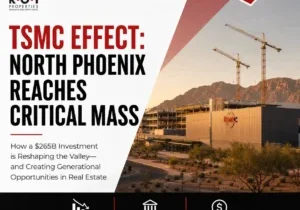
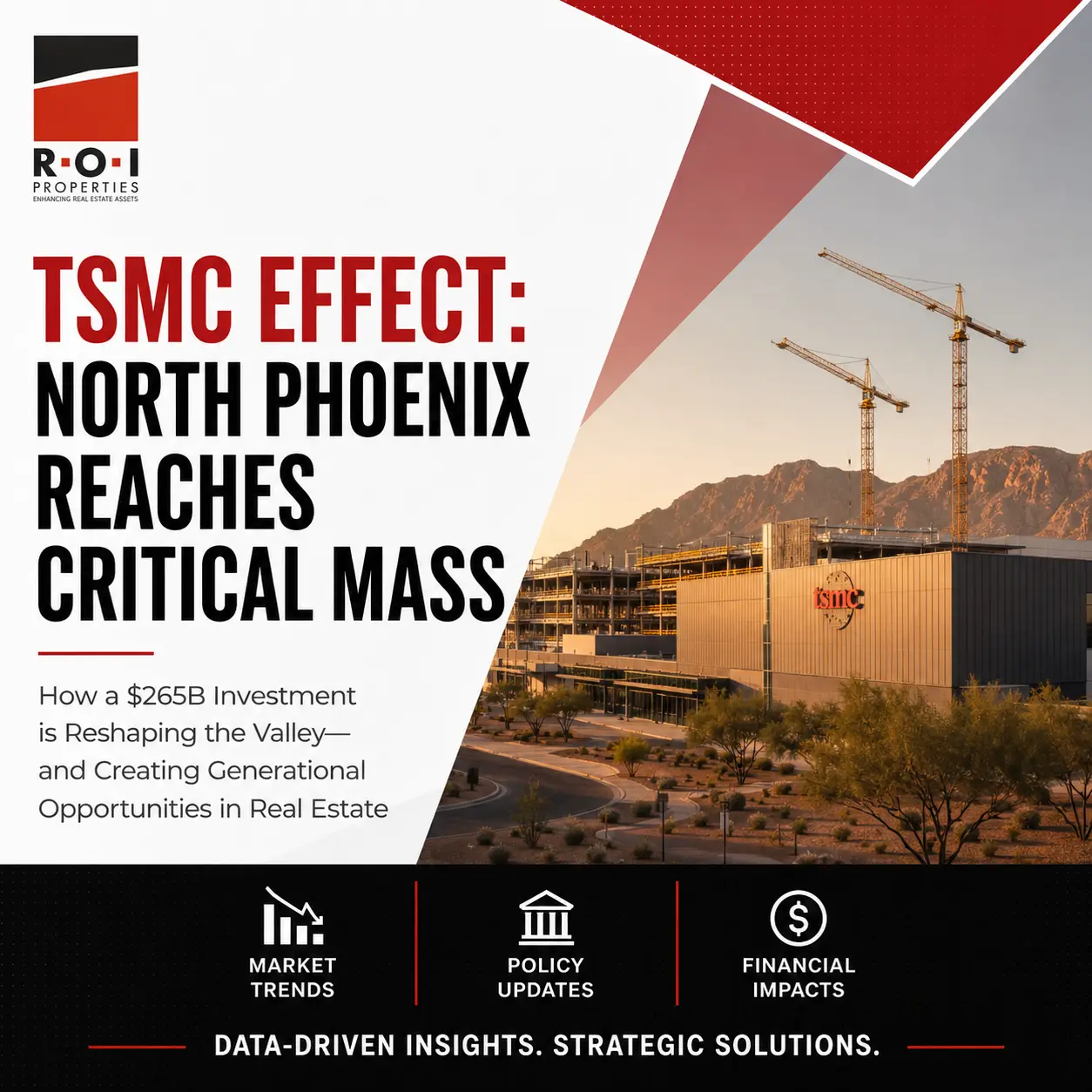
Since 2020, Taiwan Semiconductor Manufacturing Co. (TSMC) has generated significant buzz—along with development—in the Northwest Valley. At the end of July 2026, TSMC announced an additional $100 billion investment, increasing its pledged spending to $265 billion. Although that is the headline-grabbing number, the story goes far beyond TSMC itself. The impact of a burgeoning semiconductor hub extends into the company’s supply chain vendors, the people, and the cultural aspects of international commerce in the Greater Phoenix area—and most recently, the announcement that Taiwan’s government will open a representative office in Phoenix to help expand trade ties with Arizona and support investment in the area.
We recently sat down with Jill Yen JD, MRED, and R.O.I. Vice President – Commercial Division, who represents numerous Asian clients throughout the Valley, with a particular focus on North Phoenix.
STAY ON TOP OF THE MARKET
Subscribe to R.O.I.'s Real Estate Newsletters to get the latest news on Arizona's real estate trends.
Can you tell us a bit about your observations of how TSMC has transformed the North Valley?
Jill Yen: The growth that North Phoenix is experiencing is just astronomical. TSMC originally announced that they were going to build three or four semiconductor fabs, and then it became six, and now probably over 10—and that’s in addition to two packaging and testing facilities and one research and development facility that was announced earlier this year when TSMC purchased an additional 900 acres of state trust land just south of the 303. Add to that the recent announcement of an additional $100 billion, and you can start to comprehend the level of commitment and the potential scope.
How has that impacted TSMC’s suppliers?
We’re not just seeing companies come and take up space that’s already there. They are fueling the next two or three decades of growth. Companies that might have been sitting on the fence a few years ago can now see that everything has reached critical mass, which shifted them from short-term planning to mid-to-long-term planning. Now, instead of leasing for three to five years, it makes sense to buy land and build their own warehouse that can be used for a decade or more.
With that influx of activity, what is the dealmaking climate and pricing like now compared to last year?
Pricing all about supply and demand, and the Deer Valley submarket in particular has very little supply. Developers are building huge, 100,000 SF warehouses that they hold on to and lease because they’re looking for cash flow. Beyond that, whatever comes on the market, the seller holds all the cards. For buyers, whoever’s able to offer the best price and the best terms wins. I recently had a client who was interested in an older flex industrial property, where you have an office and warehouse component in one. There ended up being seven potential buyers and a bidding war, with a property that might have sold for $275/SF last year selling for almost $100/SF more. That would have been unthinkable even six months ago.
We are seeing a decent number of sellers offering built-to-suits, with prices at around $400/SF for a spec, and if you want any customization done, that pushes the price up to $450/SF. That doesn’t really solve the supply problem, because it will be 16 to 18 months at least before you can move in and use your building. Sellers are essentially pricing not at today’s levels but what they expect prices to climb to a year and a half from now.
At the end of June, there was a great example of how competitive the North Valley market is for land. Taicoon Property Partners, a Taiwanese company, outbid heavy hitters such as Vestar and Mack Real Estate Group to win a state land auction for two parcels for $88 million, both on I-17. The amazing thing was that Vestar had done a lot of background work—environmental testing, reporting and rezoning—only to have Taicoon come in out of nowhere and scoop up the properties.
What are you seeing specifically from Asian business owners or investors, as far as what they’re interested in acquiring or developing?
Beyond industrial properties, my second most common client request is for multifamily properties, since housing is a common employee benefit for the people who come over from Taiwan. A lot of the multifamily product being built in the area is class A with hundreds of units selling for hundreds of millions of dollars, which isn’t going to work for a smaller vendor or supplier that only needs to house 20 or 30 employees at a time. As a result, one of the workarounds is to buy single-family homes. For example, I recently helped a client buy six individual four-bedroom houses in the area.
What are the main challenges you’re seeing, and what are the opportunities that go along with addressing them?
JY: There are quite a few, but the first, as I mentioned is housing. North Park, just south of the 303, should help fill in the critical housing shortage with a mix of single- and multi-family housing units. Along with that, the other is shopping. Phoenix’s primary Asian retail infrastructure is all in the East Valley, more than an hour away, during peak traffic times. So, what I’m seeing is that the next wave of investment and development is going to be focused on providing those amenities within convenient distance.
There’s huge potential to open up opportunities for developers and investors to import Taiwanese brands that TSMC and TSMC-adjacent employees are familiar with. Think of it as bringing a piece of home to North Phoenix that’s not just a rinse-and-repeat of Asian-themed US chains. Ideally, it would approximate what we see in Southern California or the Bay Area, where the conveniences are all in one place. I know there has been some interest from California-based Asian shopping center owners, but there’s not necessarily enough critical mass yet to support a large-scale development. In the meantime, an affluent area like Desert Ridge could be a compromise, drawing on adjacent areas rather than relying solely on Asian shoppers.
What are some of the other initiatives that are bringing visibility to potential Taiwanese companies and investors?
JY: The Greater Phoenix Economic Council (GPEC) has been a huge influence in the TSMC project, along with fostering economic ties with Taiwan and other Asian countries in general. R.O.I. recently joined as an investor in GPEC to increase our connections in that space. The other game-changer has been direct flights between Phoenix and Taiwan on Starlux and China Airlines. I’m optimistic that the Taipei Economic and Cultural Office will help as well. All of those initiatives will help make people more aware of Phoenix as a destination, and it makes it easier for them to come see in person what it’s all about.
How does your background influence how you approach your work with TSMC and related companies?
JY: I grew up in Taiwan and immigrated to the US with my family when I was in my teenage years, so I understand the cultural and the language barriers that my clients face when they come here for the first time. Because it’s the initial foray into the US by TSMC and their supply chain vendors, they’re not necessarily familiar with many of the cultural, legal, and operational challenges. That means a lot of education and some handholding by a person they can turn to and trust, whether they have questions about insurance, rezoning, or permitting, not just finding a property. In the Asian community, it’s really about the relationship rather than the transaction.
Learn More About Our Full-Service Brokerage Firm
Contact Us