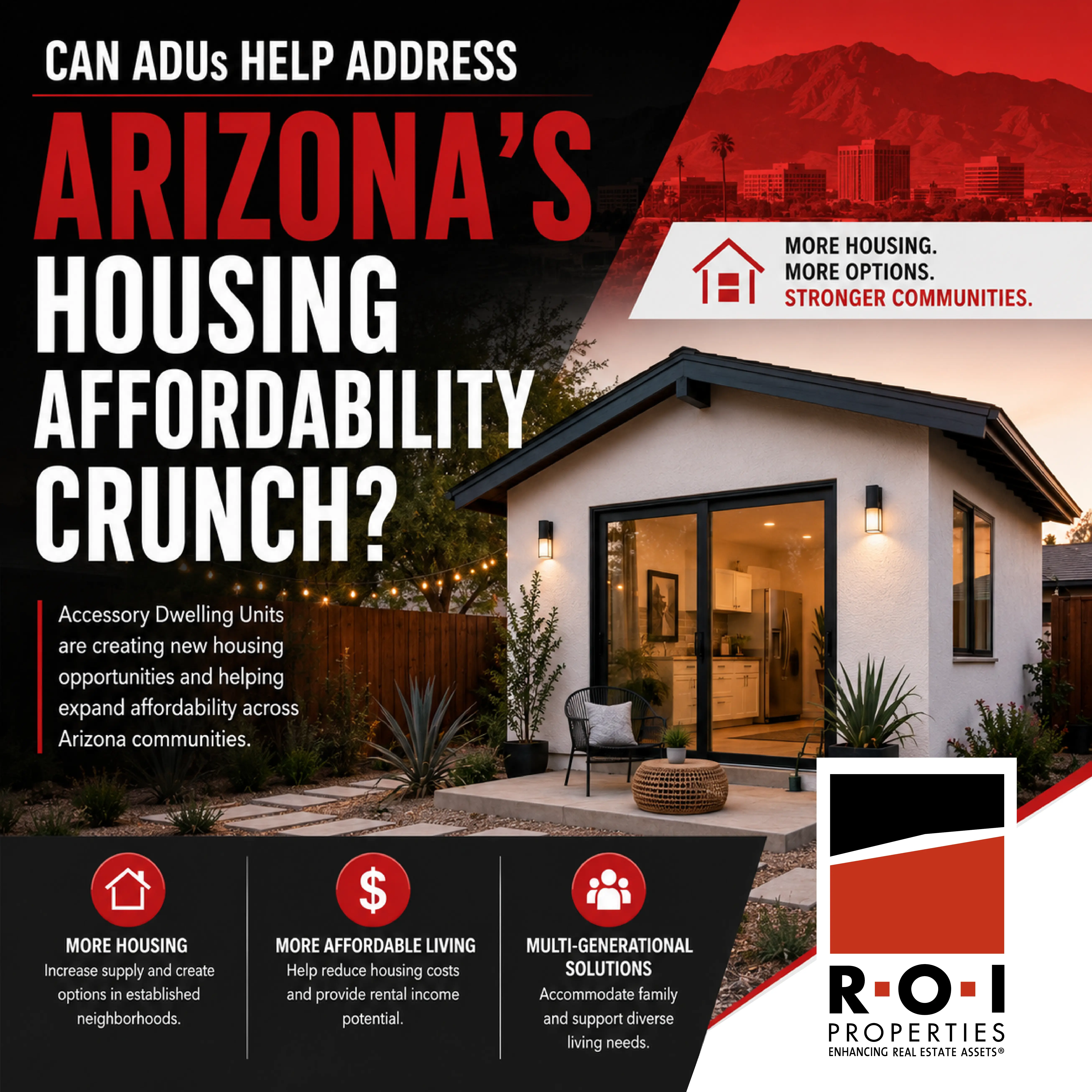
In the past two years, two bipartisan Arizona laws have broadened the ability of homeowners to build auxiliary dwelling units (also called accessory dwelling units or ADUs) on lots zoned for single-family homes in cities with more than 75,000 people. While the state has streamlined the overall guidelines via House Bill 2720 in 2024 and House Bill 2928 in 2025, there are still specific size, setback, and zoning rules to follow, and individual cities handle details such as permitting, inspections, and certificates of occupancy.
Colloquially known as casitas, guest houses, or backyard rental units, ADUs can be a route to more affordable housing. In some cases, they make it easier to accommodate a multigenerational living situation. In others, they can provide a pure rental guest house concept. Because many cities allow one attached and one detached ADU, that can help generate an income stream and/or create options for a new homeowner or someone who would not otherwise be able to afford a home. For investors, the opportunity can be in properties with existing ADUs or the space to add them; given strong demand and relatively little current supply, it is a way to significantly increase rental income from a single property.
Is It Time to Take Advantage of Arizona’s New ADU Laws?
Considering adding an ADU to your property in Arizona? Before you break ground, there are several cautionary notes to keep in mind:
- Make sure you are in compliance with the ADU requirements of your city, such as architectural plans, building permits and construction standards.
- HOAs technically cannot ban ADUs, but there may be private covenants or deed restrictions to be aware of.
- The rise of ADUs has been controversial in many cities and neighborhoods, particularly historic ones, because of their impact on the character of the neighborhood. Tempe is just one of many examples. Scottsdale attempted to work around the laws before eventually relenting.
- Finally, be on the lookout for unethical contractors capitalizing on the trend. In April, Arizona Attorney General Kris Mayes warned citizens about an emerging scam targeting homeowners seeking to build ADUs. She cited examples of people losing tens or even hundreds of thousands of dollars after making upfront payments to construction companies that did not obtain needed permits and never even started on the projects. For protection, it is recommended to get multiple estimates, hire contractors in good standing with the Arizona Registrar of Contractors, and never pay the full amount up front.
It’s also interesting to note that the boost to ADUs is not just an Arizona trend. As of the most recent statistics, 18 states across the country have passed laws specific to accessory dwelling units, along with thousands of cities.
Housing Supply, Demand and Overall Market Performance in May
From April to May 2026, the supply-demand index decreased from 83.1 to 82.0, with the supply index up from 106.6 to 107.2 and the demand index down from 88.6 to 87.9. Mortgage rates saw another volatile month, fluctuating from a low of 6.4% to a high of 6.75% before drifting back down to 6.6%, but buyer demand performed better than expected. As all eyes are fixated on inflation due to trade uncertainty, personal income per capita in Arizona has been on the rise, ranking our state #7 in the country for a 4.3% annual increase per the University of Arizona. The Bureau of Labor Statistics reported the May average hourly rate for Greater Phoenix as $37.45, up 31% since 2020. That is nearly $78,000/year for a full-time annual employee. Assuming a dual-income household, that puts a median-priced single-family home well within the affordability range for a couple making $140,000/year.
Active Listings Remain Low
New listings in April totaled 9,414 in the Arizona Regional MLS, down 7.7% from last year. May new listings are trending nearly 9% below last year to date, which is contributing in part to overall supply counts down 6.2%. Historically, new listings added weekly to the MLS are at the second lowest count in 25 years, the lowest being 2023. May and June are high months seasonally for cancelled and expired listings; it’s not unusual to see cancellations rise 10-15% between April and June, and expired listings rise 15-25%. They are even more pronounced in the luxury market, where sellers often remove their homes from the MLS for the summer.
The combination of fewer listings added and seasonal removals of listings for the off-season is contributing to the declining supply counts over the past two months. Even with the decline, 2025 and 2026 supply counts are still at levels not seen since 2014, which makes the market challenging for sellers at the current level of demand. Adding to frustrations, conflicting headlines in May made statements that local supply is both at a record high and at a shortage. While supply is at the second-highest level in 11 years, neither 2025 nor 2026 reached a record high. That honor is given to November 2007, when supply reached nearly 58,000 listings in the Arizona Regional MLS and did not drop below 30,000 until April of 2011. Analytics are not pointing to a severe housing shortage either. Shortages typically coincide with rising asking prices and fewer price reductions. The opposite is occurring. Today’s measures show that inventory is within normal range based on 25 years of data.
Home Sales Up, Per-Square-Foot Prices Down
April sales closed at 7,145, up 2.9% over last year’s April count of 6,944. With a few closing days to go in May, sales to date were up 9.4%. That equates to an extra 417 closings so far before the month ends. The market under $300K is showing the most improvement, up 31% month to date with 158 more closings, mostly condominiums. The second-best improvement by the numbers is the $300K-$400K market, up 110 closings for an increase of 11% so far. In third place is $1M-$1.5M, up 27% with an extra 55 sales. While those were the top performers for May, all price points were up over last May heading into the end of the month. Even so, listings under contract waiting to close over the next 4-6 weeks are up 7.8%, which is a positive trend for June closings.
While the median sales price for May was unchanged, sales prices per square foot were down slightly from last year. This indicates that buyers are getting more square footage for their budgets:
- The sales price per square foot collectively for all homes under $1M, representing 91% of sales, is down 2.4% over the past 2 years, which is about 36 extra square feet for the money.
- Properties under $300K are down 5.8%, however. For a buyer with that budget, it’s an extra 70 square feet for their money. That’s just about the size of 1.5 king-sized beds, which can make a big visual difference in closet space, laundry rooms, kitchens, and larger bedrooms.
Buyers are noticing, too. Listings under contract for studio and one-bedroom condominiums are up 73% over last year as the median 2026 price has dropped to $198,000.
Learn More About Our Full-Service Brokerage Firm
Contact Us