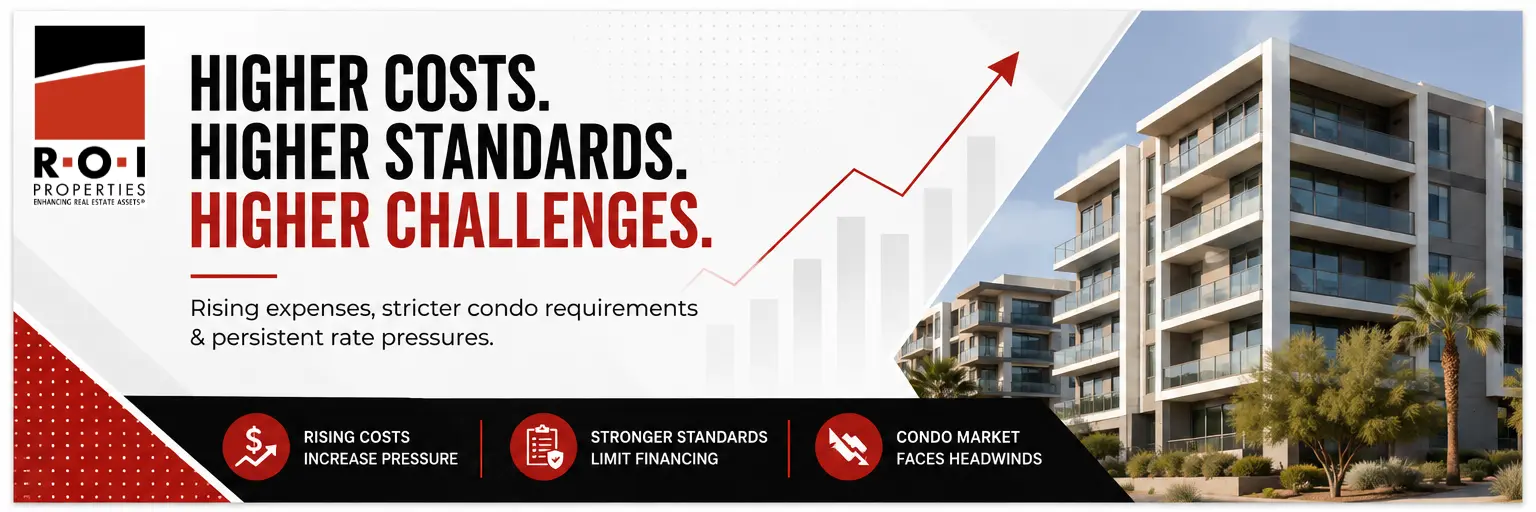
Condos have had a rough go of late in Greater Phoenix and nationally, and it is worth considering the multiple headwinds that are buffeting this sector of the housing market. The first behind-the-scenes factor is that many condo complexes were built to be heavily amenitized in order to attract buyers. While that is a benefit on the lifestyle side of the equation, the costs add up quickly. Utilities, labor, equipment, management, and maintenance expenses and master insurance premiums are all up—along with HOA dues and special assessments. Although the Federal Reserve held rates steady at the July 29 meeting, they reiterated their commitment to bring inflation back down to the 2% target, which could indicate a future rate hike and no relief on mortgage rates.
Although luxury-tier condo owners may be able to absorb those additional costs, the same is not true within the lower/middle market, since buyers may have already stretched their budgets to make a purchase and are struggling to keep up with inflation. As a result, the condo dynamic reflects the bigger affordability dichotomy in the market: Entry-level and move-up are flat, while luxury demand and prices continue marching upwards.
STAY ON TOP OF THE MARKET
Subscribe to R.O.I.'s Real Estate Newsletters to get the latest news on Arizona's real estate trends.
Headwind #2: New Condo Underwriting Standards & Reserve Requirements
As if it wasn’t already difficult enough in the condo market, sellers and buyers may find financing gets tougher in the coming months:
- On August 3, Fannie Mae and Freddie Mac began implementing numerous guideline changes to their condominium underwriting standards that had been announced in March. The first is a new “Full Review” process that requires lenders to examine financial and structural aspects of a condo—and to get documentation from the association—rather than just focusing on buyer qualifications.
- On January 4, 2027, associations will need to increase their allocation of their annual budget to a replacement reserves account from 10% to 15%. Those are the funds dedicated to maintaining infrastructure components through their usable life, whether elevators, pools, tennis courts, sidewalks, etc. Associations with recent, qualifying reserve studies and funding levels may be exempt; for those that do not, another HOA fee hike can be anticipated.
How Will the ROAD to Housing Act Affect the Phoenix Market?
In addition, Fannie and Freddie aren’t the only policy changes affecting the housing market. The 21st Century ROAD to Housing Act, enacted in July, intends to increase the supply and affordability of homes over the long term through relaxing zoning and permitting requirements, updating manufactured housing regulations, and improving financing options. While the federal government has control over national regulations, the new law does not require local city and state governments to adopt these measures. Instead, it created an “Innovation Fund” of $200 million per year over five years to provide additional federal funding incentives to those cities that successfully ease zoning and permitting regulations to promote the development of affordable housing, especially in designated Opportunity Zones.
The ROAD to Housing Act does not do much to incentivize buyers in housing, however. Most of it focuses on adding entry-level homes to supply and restricting institutional buyers from owning more than 350 homes, with some exceptions. Builders are not expected to ramp up permits and building right away in this low-demand environment. Permits are down 39% from where they were 5 years ago, but should mortgage rates decline and demand return, incentives from the new law will allow builders to meet buyers’ needs more quickly.
Key Housing Data Points in the Greater Phoenix Housing Market
From June to July 2026, the supply-demand index decreased from 81.4 to 80.5, with decreases in both supply and demand. Since demand dropped a tad faster than supply, the overall index drifted further into a buyer’s market. Some of the key housing data points include:
- New listings in June totaled 7,748 in the Arizona Regional MLS, up 1.7% from last June’s count of 7,622. That puts the 2nd quarter down 4.8% at 25,494, and total new listings through June down 3.8%. All listings for sale are also down 4.8% and with the supply index at 101.1, the current level is considered within the normal range for this time of year.
- Active rentals in the MLS are down 17.6% except for 1-bedroom units, which is the only segment that’s up, at +7.2%. Apartment List reported an 8.1% vacancy rate for 1- and 2-bedroom units in Maricopa County, up from the pre-Covid level of 5%. This explains the 33% increase in condo listings under $200k. The monthly median apartment rent for 1-bedroom units is $1,100 in the MLS, down from $1,250 in Q1 2024. Increased rental supply, declining rent, and rising HOA fees in this segment has made small rental condos less attractive to landlord investors.
- June sales closed at 6,612, up 7.1% over last June. That puts total sales through ARMLS for Q2 up 4.5% at 20,692 and up 4.0% for the first half of the year at 37,811.
- Closings this year have outperformed 2025 and 2024 so far due to consistently better contract activity in the first half, but July did not see this trend continue. The weeks surrounding the 4th of July weekend were the weakest on record in the past 12 years. As a result, total listings under contract is 1.2% below last year and the demand index reads 81.4, nearly 19% below normal for this time of year.
- While challenging, demand is not at a record low and has improved over the past few years. In December 2023, for example, the demand index was 31% below normal. Prices below $600K continue to decline, while those above $600K are either stable or rising.
- As Greater Phoenix continues to gain attention and growth internationally, the demand for luxury housing has become staggering. Sales over $10m are already up 53% over 2025’s count for the year, achieving a new record—and the year is only halfway through.
Learn More About Our Full-Service Brokerage Firm
Contact Us